
I would like to welcome you to the 2nd 18th AIF Infantry Battalion Association 2023 Newsletter.
Since the last newsletter we have held the 2022 Christmas lunch at Roseville RSL where we had an enjoyable time. I always enjoy the company at this lunch.
We had a successful 2023 ANZAC Day March and lunch and for further information on ANZAC Day see the report and photos in this newsletter. It was certainly great to have the Cadets from Hurlstone Agricultural High School return to help carry our banner.
We have not been able to spend as much time on digitising our archives as we would like but it is an ongoing project. As you can imagine we are dealing with documents that are nearly 80 years old and we have to be very careful with the fragility of some of them.
Liz, Will and myself spent July in England, Scotland, Wales, Norway and Sweden. It was an enjoyable holiday. One of the interesting and educational experiences was visiting the Imperial War Museum (North) in Manchester, this added to my previous visit to the IWM in London. We are very lucky to have war museums for future generations to remember the sacrifice of those who have gone to war for our freedom. The Australian War Museum is certainly one of the best in the world.
A reminder to visit our Facebook page and website for updates and also interesting information about the battalion.
We are always happy to hear from anyone who as any questions concerning the 2/18 AIF Infantry Battalion, please do not hesitate to contact us at any time.
Evan Richard
President 2/18th Infantry Battalion Association
Dates for your calendar 2023/24
- 5 December 2023, 12 noon, Christmas Lunch Roseville RSL
- 15 February 2024, 82nd Anniversary of the Fall of Singapore 11am, The Cenotaph, Martin Place, Sydney
- 25 April 2024 ANZAC March and lunch, 11am, Club York, 95 York Street, Sydney
ANZAC Day 2023
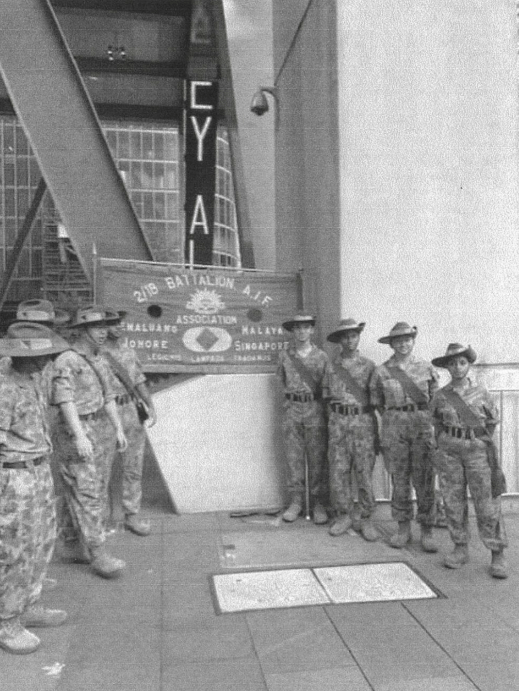
It was a bright sunny day this year and when we arrived at the meeting point a couple of Venturers volunteered to help Evan and I set up the Battalion banner. The cadets from Hurlstone Agricultural High School were there waiting for us and eager to march. It was great to have the cadets initiate contact with association, after a period of COVID restrictions, and volunteer to accompany us at this year’s march.
We must thank staff member, Vivienne, from the school, who was in charge of the cadets on the day and who made the initial contact. Sidd from the cadets and Matthew Angus, grandson of battalion member, Ted Colenso, held the banner and the other cadets marched alongside holding the guy ropes. A total of 33 people marched behind the banner this year, made up of the family members and a few members of the cadets’ families. It was nice to meet the cadets’ parents who proudly marched along with our group. On a personal note, five of my six siblings and some of their children and grandchildren, marched behind the battalion banner, remembering our father Merv Blyth and his brother Arthur (Tas or Snow as he was known).
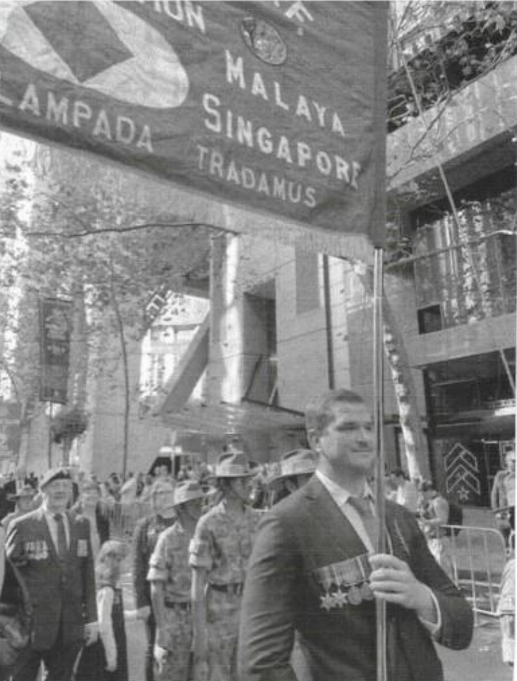
Large crowds lined the streets this year and they all gave us applause and a wave. There were lots of bands playing and Col Wright commented that they made it easy to keep in step.
After the march we made our way to Club York to gather for our traditional luncheon. 39 people attended this year and we must thank Joan Okey and Diane Humphries for their organisation, as well as Julie and her team who catered for us at the club. It was good to see some old faces return to the luncheon as well as a few new faces and their families.
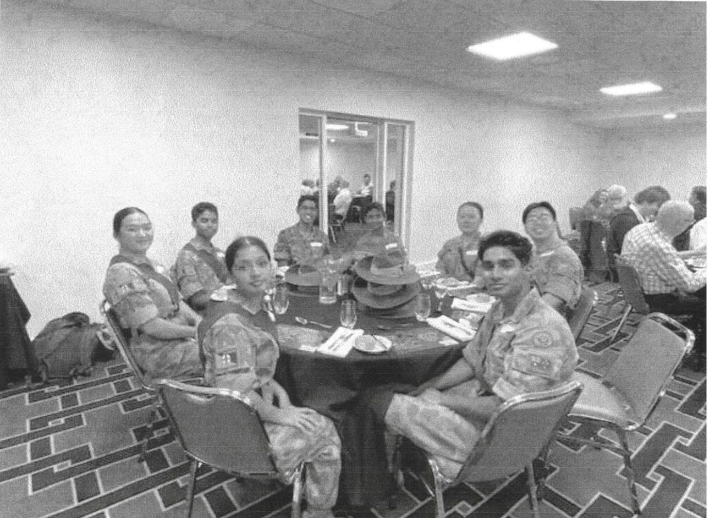
Rashid spoke on behalf of the Hurlstone cadets and gave an entertaining and enlightening insight into the history of the cadet corps at the school. Joan and Diane set up a display of battalion memorabilia and the cadets were particularly interested in the Gurkha knife and the Japanese officer’s sword which was handed to Major Doug Okey after the Japanese surrender.
I searched the internet to find more information about the knife, known as a kukri. It is a short sword with a distinct recurve in its blade and originated in Nepal. It served multiple purposes as a melee weapon and also as a regular cutting tool.
The cadets chatted with our guests at the luncheon and were very interested in finding out the history of the 2118th Battalion AIF. They are keen to volunteer with us again next year and carry on the tradition of the ANZAC Day march.
Overall, it was a great day to get together, commemorate and remember the sacrifices made by those brave men of the 2/18th Battalion AIE.
By Liz Richard (daughter of Merv Blyth).
President’s Report – ANZAC Day 2023
I would like to pay thanks for the service of all members of the 2/18th AIF Battalion
8th especially those who paid the ultimate sacrifice.
Another year has passed and here we are 108 years since the ANZAC legend was and 81 years since the Fall of Singapore. Ancient history for younger generations, but still very close for us who had grandparents in World War 1 and in World War 11.
I would like to welcome everyone to our 2023 ANZAC Day Lunch so that we can pay to the men and families of 2/18th AIF Infantry Battalion. ANZAC Day to me is about remembrance and giving thanks.
I would especially like to thank Hurlstone Agricultural High School Cadets who have sad a close relation with the ANZAC Day march and the 2/18 th Battalion and they our march this year after a period where they were unable attend that included COVID-19.
During the last year we had a small group who attended our Christmas lunch at RSL
and would look forward to anyone who may be able to attend 4 December 2023.
Diane Humphries represented the Association at St John’s Anglican Church Gordon ANZAC Commemorative Service last year and the service is on again this Sunday 30 April 2023 at 11:00am and all are welcome. Here you can view the Mersing Cross and other artefacts including Battalion’s Colours. Unfortunately for the second year I be unable to attend.
We are still in the process of digitising the Association’s archives that are loving looked after by Joan. The digitising is a slow process taking into account that most of between 75 and 80 years old. Joan, Diane and Liz are doing a great when we get together digitising whilst I have a very educational time reading the archives. As we have mentioned previously, we need to decide who has access to the digitised archives and then where we store the originals.
It is great that we have many ways of keeping in touch through the website, Facebook, email. We must again thank Diane, Lachlan and Jamie (way off in the USA) for this to happen.
Lastly, I would ‘like to thank the other committee members who help to keep the Association going. Thanks Joan, Diane, Robyn, Col and Lachlan.
Evan Richard
Presentation to 2/18th AIF BN Association
Date: 25 Apr 2023
Presented by: CDTSGT Rashid Abuzarov
Ladies and gentlemen, hello, I am Cadet Training Sergeant Rashid Abuzarov, and I was
given the task of telling you all about my army cadet unit, HAHSACU, and why it’s so
good and why you should like us and be friends with us.
If you aren’t already familiar, we are a moderately sized school-based cadet unit from a selective school in Western Sydney that goes by the name of Hurlstone Agricultural
High School. Our school has had a cadet unit in some form or another since around 1914.
Historically we haven’t been the largest or wealthiest unit but given the chance we can still find some things to brag about.
Like how in 2004 and 2005 our unit produced two consecutive New South Wales Army Cadets of the Year and in 2005 also participated in the handover of the Duke of Edinburgh Banner at Victoria Barracks, in Paddington. How in 2022 the state positions of Brigade RCUO and Brigade CDTRSM in NSW were simultaneously adopted by two Hurlstone army cadets, Rupert Fuelling and Hamza Jamil, who don’t really visit us anymore, unfortunately, but who we’re all proud of nonetheless.
While the wild days of cadets carrying rifles and participating in military training camps, which I’m sure some people here remember vividly, are long over, our unit still strives to retain a spirit of adventure and purpose through exciting activities, overnight camps and community involvement, such as what I’m doing right now.
Notably, one of the unit’s foremost functions has been to provide a public face for the school at Anzac and Remembrance Day commemorations through catafalque parties for services in the school’s Memorial Forest and at local primary schools.
Coming back to history, the current iteration of our unit has been operating continuously since the 1970s, not buckling under the tests of time or numerous changes in government.
Don’t get me wrong, we’ve come close. We’re by no means perfect. Even when I first joined, just over 2 years ago, the unit was in the awkward position of having more instructors than junior cadets. At that point the pandemic had wrung the calendar dry of camps and outside activities – that is, the stuff that’s supposed to make cadets fun and our operations were confined to a cramped and rather mouldy corner of the school grounds and strangely, I look back on those days with nostalgia.
I’ve often wondered why those of us that stuck around during that rough patch did so in spite of it all, and it’s now when we have more space and camps and cadets that I realise that it was because of the people. I wasn’t staying out of some masochistic desire to put myself through yet another power point presentation on Dress and Bearing, and definitely not out of my amazement at us producing two consecutive Cadets of the Year in 2004, as impressive as that is. I was staying to hear the witty quips of our CUO Luke Bui, and the impassioned bivouac horror stories of our CPL Gangodage; I was staying for the cheerful desperation of trying to set up our hutchies on a damp night, and the small talk around cheese and crackers during afternoon tea.
So truly, I could go on about the various honours our unit has achieved and the awards we’ve won, but if I’ve learnt anything in my time being here it’s that that’s not what we’re really about, and that if you want to get to know us, talk to us. We all have the pleasure of being here with CSM Siddharth Sali, TRGO Rylan Le, Platoon Sergeants Princess Subedi, Arnav Mane and Jasmine Le, Unit 21C Vivien Tang, and Unit OC Rick Vincenti, each their own troves of stories and insights, and I’m sure each eager to hear all of yours.
Thank you for giving us this chance to speak and I’ll let you, Evan, get on with the lunch.
Treasurer’s Annual Report 2/18th Battalion (A.I.F) Association for 25 April 2023
Opening Balance 1/04/2022
Bendigo Bank: $5,147.58
Plus income:
Donations: $200.00
Books: $118.00
Interest: $26.40
Prepaid ANZAC lunch: $365.00
Total: $709.40
Less outgoings:
Newsletter: $563.61
Website: $347.45
Wreaths: $80.00
Donations: $200.00
Total: 1,191.06
Closing Bendigo balance 31/3/2023: $4,665.92
List of marchers at ANZAC Day 2023
David Blyth
John Blyth
Alison Job
Cathy Dowling
Liz Richard
Julie Whitehouse
Helen & Paul Askew (father Jim Crawford)
Phil Bannister & daughter Teagan & her daughter Iona (father Robert Bannister).
Jan Murphy (grandfather R.F. Behrend)
Matthew Angus (grandfather Ted Colenso)
Michael James
Col Wright
Rick Clive
9 cadets & 3 family members
Committee Nominated at A.G.M. 2023.
President:- Evan Richard
Vice President:- Lachlan Simond
Treasurer:- Diane Humphries
Secretary:- Joan Okey
Members:- Robyn Simond
Liz Richard
Col Wright
Australian War Memorial’s stunning Hall of Memory stirs the soul
World War 1 claimed up to 40 million lives, soldiers and civilians.
We should never forget cost of a generation lost. We honour those who paid the supreme sacrifice on Anzac Day on April 25th the date the original Anzacs landed at Gallipolli — and Remembrance Day, at the 11th hour on the 11th day of the 11th month.
Germany’s surrender on November 11th, 1918, ended one of the deadliest wars in history. It led to seismic-societal and geopolitical change, revolutions and, of course, another world war and the holocaust.
The 1914-1918 war profoundly changed Australia too. Of a nation of 5 million, over 400,000 enlisted, of whom almost 62,000 were killed and 156,000 wounded, gassed or taken prisoner.
Many Anzacs have no known grave. But we have our symbols to honour all victims of that ghastly war: the Flanders red poppies, the first to bloom on the blood soaked Western Front; rosemary which grows on the Gallipolli Peninsula and is an ancient symbol of remembrance; our avenues of honour and war memorials in practically every town around the nation.
And the most poignant of them all, the Australian War Memorial in Canberra, with its soul-stirring Hall of Memory.
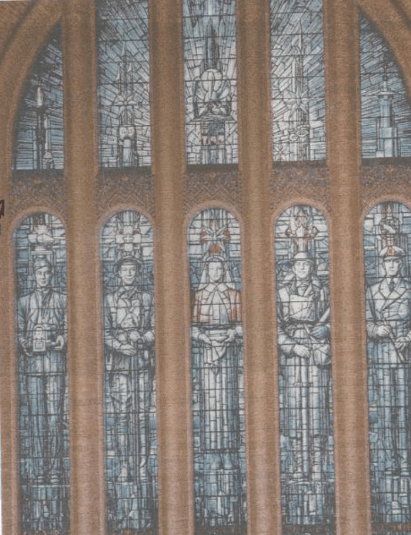
The Hall of Memory features 15 stunning stained-glass panels, each symbolising one of the quintessential qualities displayed by Australians in war.
They were created by Victorian artist Mervyn Napier Waller CMG OBE, who lost his right arm after being wounded on the Western Front in 1911. Waller learnt to use left arm and became an acclaimed stained-glass artist, muralist and mosaicist.
By the time the Hall of Memory opened in 1941, after years of delays. World War 2 had begun. The hall’s mosaics, painstakingly created by Napier and his team, were dedicated to the fallen of that war.
As you gaze in wonder at Napier’s masterpieces, you are standing by the Tomb of the Unknown Australian Soldier, at the still point of all remembrance.
Only one horse returned from Gallipolli
Between 120,000 and 136,000 Australian horses served overseas during World War 1, but for quarantine reasons none of them were allowed to return, except one.
Sandy was ridden by the Commanding Officer of the 1st Australian Division, Major General William Throsby Bridges, for 20 days in Gallipolli.
Sandy was a New South Wales horse, bred for Australia’s extreme climate and challenging work conditions. Known as Walers, they were a combination of Thoroughbred, Arab, Cape of Good Hope horses, plus Timor pony and Clydesdale.
Walers were originally considered a type rather than a breed but they were a preferred military horse and had great endurance.
Sandy was one of 61,000 horses shipped to Gallipolli and he was one of the few that went ashore because Lieutenant General William Birdwood decided they were not required.
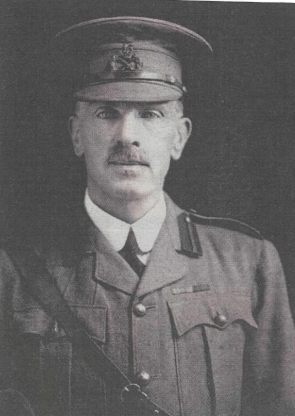
Major General Bridges landed in Gallipolli on April 25th 1915. His was the first division ashore at Anzac Cove.
A sniper severed his femoral artery on May 15th during an inspection and he was evacuated to the ship’s hospital on May 18th but he died the same day. He was 54. The Major General was initially buried in Alexandria, Egypt, however his remains were sent to Australia later that year, making him the only Australian killed in World War 1 to have his remains returned to Australia.
Major General Sir William Throsby Bridges KCB CMG was buried at the Royal Military College, Duntroon, which he was instrumental in establishing.
Military legend has that a dying Bridges asked for his beloved Sandy to be sent home. On his return to Egypt Sandy came under the care of Australian Army Veterinary Corp’s Captain Leslie Whitefield in August 1915 and the pair travelled to France in March 1916.
Australia’s then defence minister, George Pearce called for Sandy’s return to Australia
in October 1917. In May 1918, accompanied by Private Archibald Jordan, Sandy went from the Australian Veterinary Hospital in Calais to the remount depot in Swaythling, England.
Veterinary observation declared him free of disease so he could board the freighter Booral in September 1918.
Sandy arrived in Melbourne in November and was turned out to graze at the Maribyrnong defence site. Increasingly debilitated & blind, Sandy was put down in May 1923.
From the Archives
The following are some of the observations on the medical problems that confront the POW’s on Blakang Mati.
- No Red Cross medical supplies have ever been received on Blakang Mati. 2. Shortage of bandages and dressings. Sheets and clothing as they wear out are used in lieu of these, but they are very short too.
- Great shortage of ALL drugs. No drugs for treatment of amoebic or bacillary dysentery.
- Low protein diet. As a result, swelling of legs commonly occurs after fever or dysentery. Low Vitamin B content of diet affecting eyes, mouth, tongue, scrotum, palate, lips, legs. Vitamin B deficiency resulting in beri beri. There are no severe disabilities due to vitamin lack.
- Both microscopes brought to this camp have been taken from us. The MO is allowed to use one of these 3 days out of 7 by going to the IJA Hospital.
- Japanese quinine tablets have been supplied. Some atabrin but no plasmoquin tablets which would prolong the interval between relapses and which the IJA appropriated originally in immense numbers, have been reissued.
- As long ago as June 42, permission was asked for carrying out anti-mosquito work within a small radius of the barracks. This was recognised as necessary, oil and labour were promised but nothing was done further. In Jul 43 and urgently in Sep 43, after a new outbreak of fresh cases of malaria had occurred, permission was again sought. Again nothing was done. Only when the large number of malarial cases began to interfere with the working efficiency of the camp, was anti-mosquito work started. This was mostly unskilled and haphazard, and, as shown by results, quite inadequate.
- Difficulty of removing acutely ill or chronic sick to Changi Hospital. Severe injuries have been transferred immediately.
- The caloric content of the diet is not sufficient for the large majority who carry out coolie work.
- Very long hours of heavy work, sometimes extending into the night, done by men who have had repeated malarial attacks, together with inadequate diet, have brought the general state of health of some, very low.
D.T. Okey (Major) OC AIF Working Party 4 Mar 45
Camp notice
FOOTWEAR
The footwear situation is at present critical. Stocks of sandshoes are limited to a few only in size 6 and smaller. The larger sizes cannot be replaced. This condition will continue until the beginning of the IJA year, which is September or later, when a new issue will be made available.
Replacement of boots just now are out of the question.
In view of this situation, the greatest care must be taken of all footwear.
As there is no material available for repairs, all ranks must find their own if they contemplate repairing boots. It is most undesirable, and as yet unnecessary, for any man to go without footwear of some kind. It would be better for boots to become the property of a kongsi and to be lent out when a man is sick and off duty than to have men going to work barefoot.
SICK AT LUNCH TIME
If it happens that a man is taken ill during the morning and at lunch time and is sufficiently sick to be put off duty, the following procedure will be adopted:- The man feeling unwell will report to the Orderly Officer. He will then be sent to the Medical Officer. If he is put off duty, he will report to the RSM and to the Sergeant or NCO in charge of his party. When the party is called out, the fact of a man being off sick will be reported to the guard by the Orderly Officer.
CONCERT
For this month, the concert has been definitely cancelled. The reasons given are the high incidence of malaria and the enforcement of blackout regulations which make the use of lights outside impossible.
(D.T. Okey) Major
OC AIF POW Working Party
BLAKANG MATI
11 Jul.44
 218battalion.org.au