
2025 Newsletter
I would like to welcome you to the 2/18th AIF Infantry Battalion Association 2025 Newsletter.
Time certainly appears to move more quickly as l age.
We had a nice Christmas lunch last year at Chatswood RSL, with a small number in attendance. A very enjoyable time was had by all. Hope to see as many as can attend this year’s Christmas lunch — see later for the details. Unfortunately, Liz and I will be unable to attend in person as we will be on a plane returning from Perth and the First Ashes Test, but will be there in spirit.
In this newsletter, there are reports of the 2025 ANZAC Day Sydney March and our Association’s ANZAC Day Lunch. It was a very enjoyable day of remembrance. I would like to again thank the cadets from Hurlstone Agricultural High School who gave up their holidays to assist us in the March. I would also especially like to acknowledge Matthew Angus, who each year carries our Association’s banner in honour of his grandfather — and does so with great pride.
We welcome everyone to attend the march and lunch in 2026.
We have a successful Facebook page — if you have not checked it out, please do: 2/18th Battalion AIF Association. I wish to thank Jaimie and Lachlan for their initial work, and Diane and Liz for the continuing work they have done to make our Facebook page a success. We have had a pleasing number of views.
There is a nice report from Lynda Blyth, who attended the 2025 ANZAC Day Dawn Service in Singapore. We would happily accept any information concerning the 2/18th that you think would interest other members — please don’t hesitate to let us know.
The 2/18th Battalion was represented at the 80th anniversary of Victory in the Pacific Day in August. Ian Moon and Di Humphries proudly held the battalion banner alongside other members of the battalion family. You can read the report in this newsletter.
The men of the 2/18th AIF Infantry Battalion will be honoured at the Last Post Ceremony at the Australian War Memorial, commemorating the 84th anniversary of the Fall of Singapore on 15th February 2026. The member of our battalion to be honoured is NX35009 Lieutenant A. H. (Jock) Pringle. I would like to thank Jock’s family for supplying the information to the AWM, especially his nephew Neil Moon. Liz and I are certainly going to attend, health permitting.
Dates for your diary:
Monday 1st December 2025 – Association Christmas Lunch at Chatswood RSL
Sunday 15th February 2026 – 84th Anniversary Last Post Ceremony at Australian War Memorial Canberra
Saturday 25th April 2026 – ANZAC Day March and Lunch
I wish to thank everyone who has helped keep our Association alive, especially Joan, Diane, and Liz. Without them, we would not have an Association.
Evan Richard
President 2/18th AIF Infantry Battalion Association
27 September 2025
Committee:- President:- Evan Richard.
Vice President:- Lachlan Simond.
Secretary:- Joan Okey.
Treasurer:- Diane Humphries.
Members:- Robyn Simond.
Liz Richard
Treasurer Diane would like to acknowledge the following generous donations:
Helen Askew; Michael Edgar; Anonymous; Sally Harris-Leys; Olwyn Jones; Jo Saunders; Noni Staggs; Susan Thorley; Chris Veitch; Julie Whitehouse.
Recently, I received a request from Denmark concerning information about a relative who served in the 2/18th Battalion. I was able to supply some information from the archives, but there was considerably more relevant material in the battalion book, History of the 2/18th Battalion AIF. So, I was able to send a copy overseas to him. Certainly an unusual request!
ANZAC DAY 2025
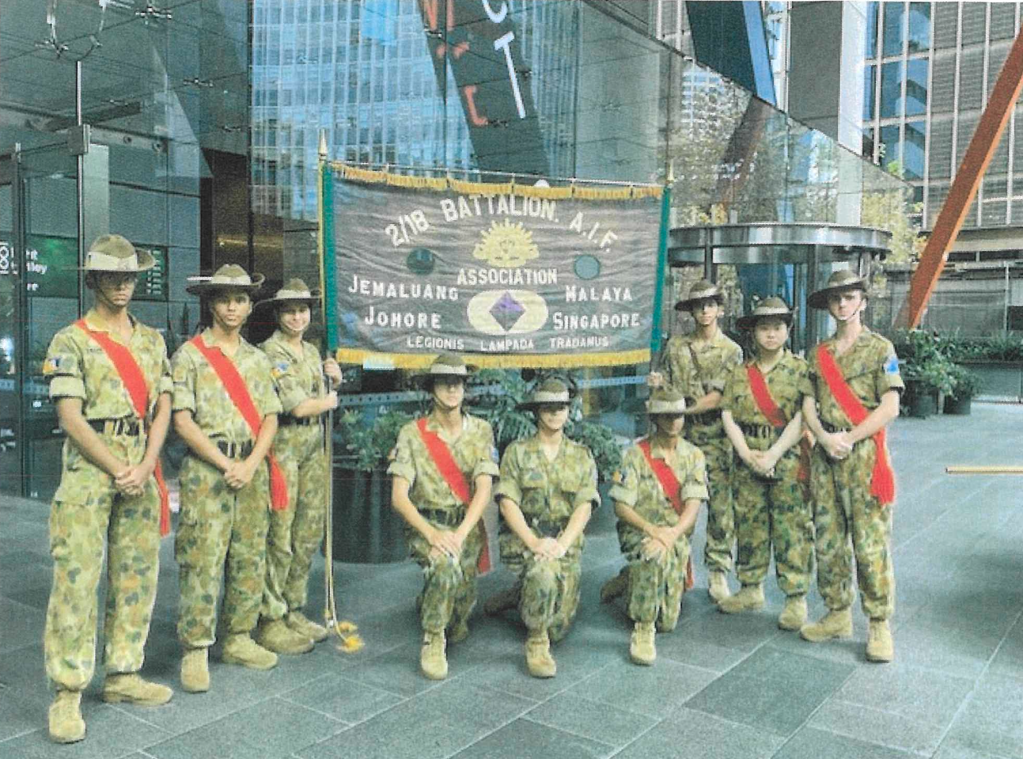
As we set up the banner, it was a pleasure to see Tanya Olsen (daughter of Cliff) arrive and join us, as well as the cadets from Hurlstone Agricultural High School who arrived eager to march. We must thank staff member Vivien Tang from the school, who was in charge of the cadets on the day.
Matthew Angus, grandson of battalion member Ted Colenso, proudly held the banner, assisted by the other cadets. A total of 28 people marched behind the banner this year, made up of family members and cadets. Those marching included myself and my sister Cathy Dowling; Scott Fuller and his grandson; Helen and Phil Askew; Sue Regan and daughter Melissa; Tanya Olsen; Julie Whitehouse; Rex Fitzgibbons and his grandson; and Lachlan and Jamie Simond and their children.
Enthusiastic crowds lined the streets this year, and they all gave us applause and a wave. We didn’t have a band near us this year, so it was hard to keep in step. The march was watched live in San Francisco, where my brother David was visiting my sister Janet. They saw us all and commented on how proudly we were marching.
After the march, we made our way to Club York to gather for our traditional luncheon. As there are ongoing renovations at the club, we were accommodated in a large room with a lot of other units. That made it very noisy, but we still enjoyed each other’s company.
Unfortunately, Joan Okey was unwell and unable to join us this year, but we must thank her and Di Humphries for their organisation of the luncheon. It was good to see some new faces at the luncheon, including Sally and Susan, whose father, Lawrence Harris, was in the battalion.
Also joining us were Vice President Lachlan Simond and his wife Jamie and their two children. They returned from the USA this year, and it was great to catch up with them again. Lachlan’s mother, Robyn, was unable to join us this year, and we did miss her — she regularly joins us on ANZAC Day and is a very important member of our Association.
Tanya Olsen informed us that her mother, Kath, is in care, doing very well, and enjoys walking.
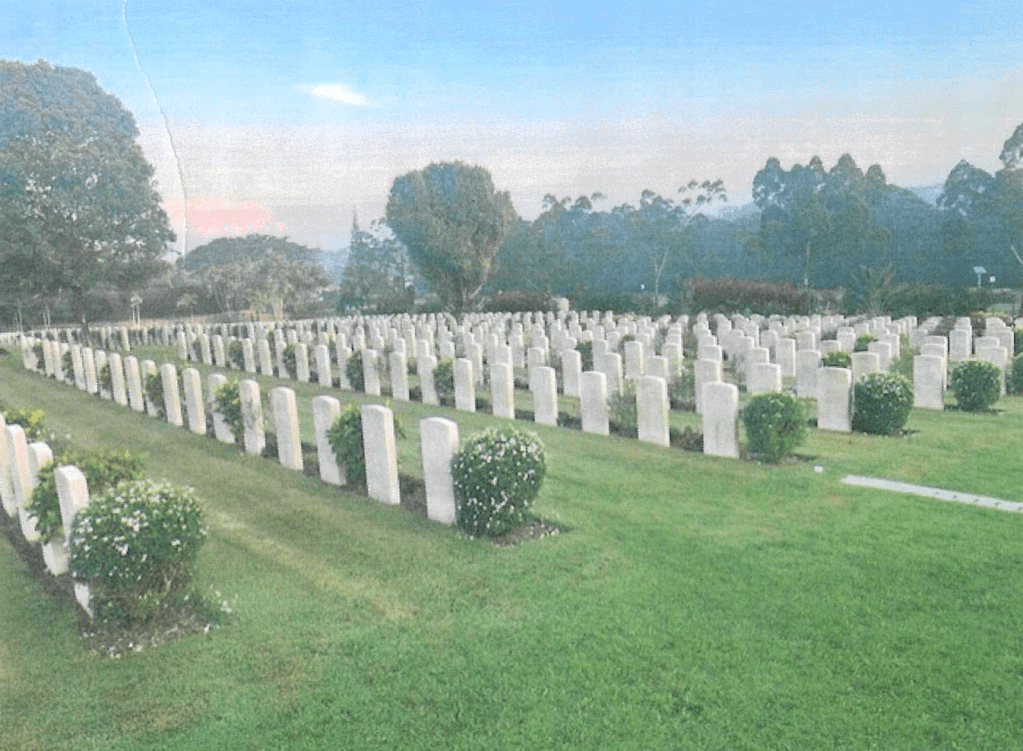
Two of my brothers, John and Bill Blyth, and their wives attended the ANZAC Day commemorations at Kranji War Cemetery in Singapore. John commented on how well the service was organised, with dignitaries from far and wide attending.
Overall, it was a great day to get together, commemorate, and remember the sacrifices made by those brave men of the 2/18th Battalion AIF.
Liz Richard




LAST POST SERVICE
1 5 FEBRUARY 2026
84th ANNIVERSY OF THE FALL OF SINGAPORE
2/18th AIF INFANTRY BATTALION
We have been given the honour of having a member of the battalion represent all 8th Division men killed in action during the Malayan and Singapore Island campaigns. We are intending to recommend the following to be the Last Post recipient:
NX35009 Lieutenant Aubrey Harold (Jock) Pringle
Jock was born in Narromine, NSW, on 21 November 1918, and enlisted at Paddington, NSW, on 13 July 1940, at the age of 21 years and 8 months. His occupation was listed as Clerk.
He had been in the AMF for three years (1937 to 1940) and had been promoted to Provisional Lieutenant from 6 February 1940 with the Sydney University Unit. Jock attended Canterbury Boys’ High School and the University of Sydney, where he gained a B.Econ.
His next of kin were his father, William George Pringle, and mother, Phyllis May Pringle, of Poole Street, Earlwood (Kingsgrove).
Lieutenant A. H. Pringle was first posted as Missing, Presumed Killed in Action, and was later shown as Killed in Action on 11 February 1942, at the age of 23 years and 2 months.
Evan Richard
President
2/18th AIF Infantry Battalion Association
Further information supplied by Jock’s family:
Jock was one of seven siblings, one of whom is still alive and in his 90s.
A really personal story is that Jock’s mother, Phyllis, was told not to cut her hair until he returned — and until her death, she didn’t cut her hair.
While completing his Economics degree, for which he graduated with honours, Jock joined the Sydney University Regiment, which would have had him well prepared for his enlistment in the AIF, which came in July 1940.
Jock travelled to Singapore on the troop ship Queen Mary, which had been converted for the purpose.
He sailed with the 2/18th for Malaya in February 1941 and was stationed first at Port Dickson, and then at Mersing on the east coast, where they trained in jungle warfare and helped build defences against any invasion of the Malayan Peninsula.
Jock was struck down with malaria towards the end of 1941 and was in Singapore’s Alexandra Hospital when the Japanese launched their invasion of the peninsula. He was released back to his battalion in January 1942, just as the Japanese were making their charge down the peninsula.
The 2/18th Battalion forced the Japanese to retreat for the first time with the famous ambush at the Nithsdale Estate rubber plantation. But that early success — which came with a heavy toll of killed and wounded — was followed by a series of retreats and strategic withdrawals south towards “Fortress Singapore.”
The 2/18th suffered heavy losses during the campaign, resulting in the battalion being broken up during the confusion of the relentless Japanese advance. Jock became a senior member of the X Battalion, a combined force of depleted companies and Indian reinforcements.
On February 11th, 1942, he was captured by the Japanese, along with Private Ted Brown of the 2/20th Battalion. Jock was believed to have been interrogated and executed not long after his capture.
Four days later, Singapore fell to the Japanese.
The Association has nominated our Vice President, Lt Col Lachlan Symond, grandson of 2/18th NX50696 Pte W. J. J. Apperley, to be part of this very important occasion.
ANZAC DAY DAWN SERVICE 2025
KRANJI WAR CEMETARY, SINGAPORE
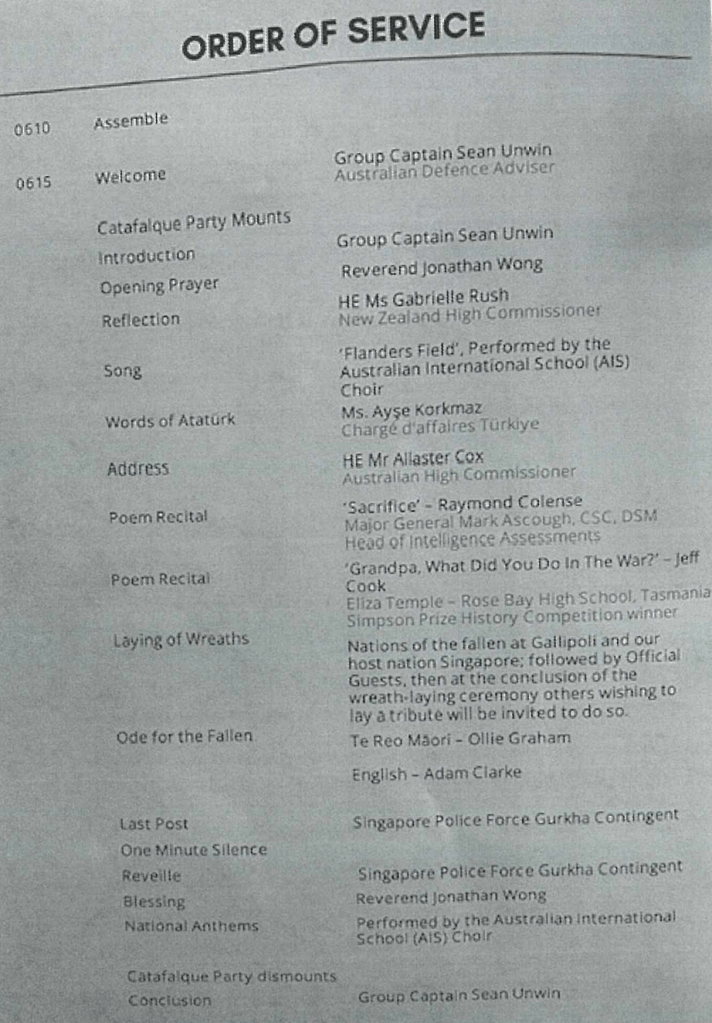
ANZAC Day this year was a particularly special occasion for Merv Blyth’s sons John and Bill and their wives, Lynda and Marian. We had travelled to Singapore a few days earlier, and on ANZAC Day we made our way, in the early hours, to Kranji War Cemetery and Memorial for the 110th Commemorative Dawn Service. It was a perfect morning, with many visitors and official guests gathered for the ceremony.
The Australian International School Choir sang beautifully, and the reading of the poem “Grandpa, What Did You Do in the War?” by Eliza Temple from Rose Bay High School in Tasmania was especially moving. The Australian High Commissioner, His Excellency Mr. Allaster Cox, gave a thought-provoking address, which was followed by the laying of wreaths from many countries around the world.
It was a most emotional experience for all of us as we remembered the fallen — and particularly our beloved Mervyn.
Lynda Blyth

Our Historian, Lynette Silver, has just had her latest book published. She sent a copy of the cover, along with some tantalising information about the subject.
The blurb:
In February 1942, Vivian Bullwinkel was the sole survivor of a massacre of 21 nursing sisters and one civilian woman by Japanese troops on Radji Beach, Bangka Island. She put on a brave face to the world for 55 years, ever since her release from the Japanese prison camp in Sumatra at the end of World War II.
The sanitised story that she was forced to tell many times is not what happened. Vivian revealed the truth about that dreadful day to army investigators in 1945 — but they censored her testimony and chose to obliterate it from the record.
Despite her best efforts, Vivian was gagged from the outset by her own government and by the Australian Army, who ordered her to remain silent — an order that, as a serving member of the military, she was bound to obey. Vivian was desperate to speak out. She knew that the truth would set her free from the years of torment. Thwarted by higher authorities — by a succession of men who thought they knew better — she was prevented from doing so.
Lynette Ramsay Silver has uncovered what really happened on Bangka Island:
“I refuse to stay silent, to be a party to any further cover-up. It is time to tell the real story of the life of this amazing Australian woman. Vivian wanted a voice. I am proud, finally, to be able to give it to her.”
RRP: $39.99 (possibly discounted online).
80 ANNIVERSARY O F VICTORY I N THE PACIFIC
It was a very moving ceremony at the Sydney Cenotaph for the 80th Victory in the Pacific commemoration on Friday, 15 August 2025. The Governor, Margaret Beazley, spoke, and Anthony Albanese was there unexpectedly, as he was not on the officially printed program.
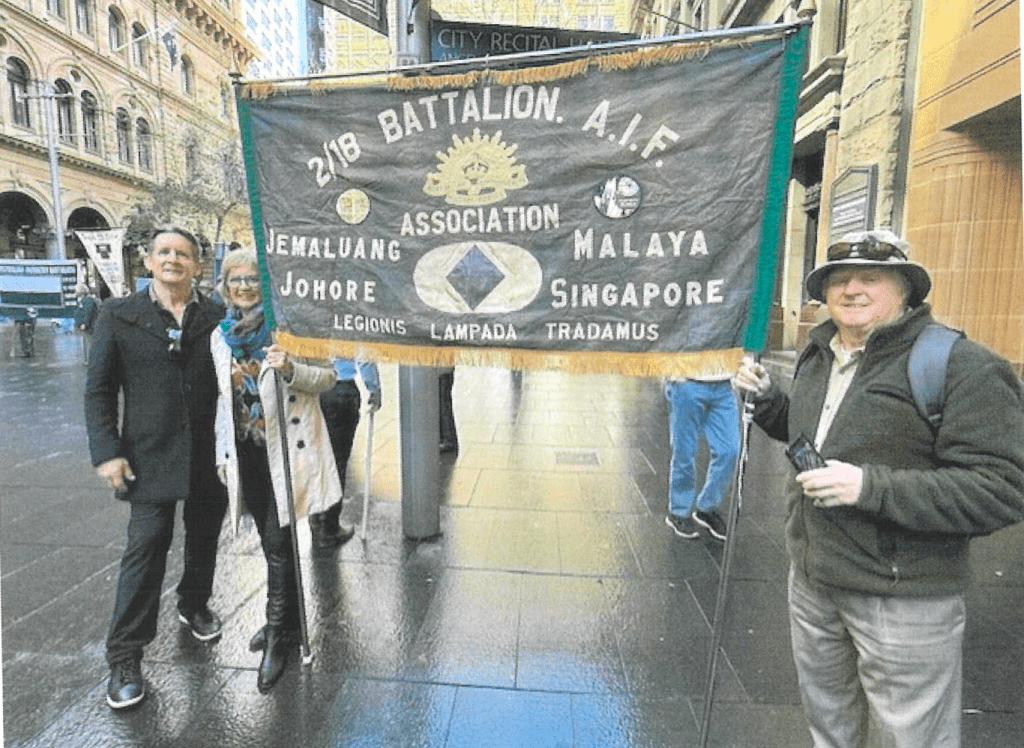
Four WWII veterans, aged 99 and over 100, were in attendance. It was great to see Alison, Bill, and Ian proudly holding our Association banner, as well as Diane, Rick, and Robert from the Association, in attendance. There were a large number of banners and battalions represented. We were next to our friends from the 2/30 Battalion, proudly representing the 8th Division.
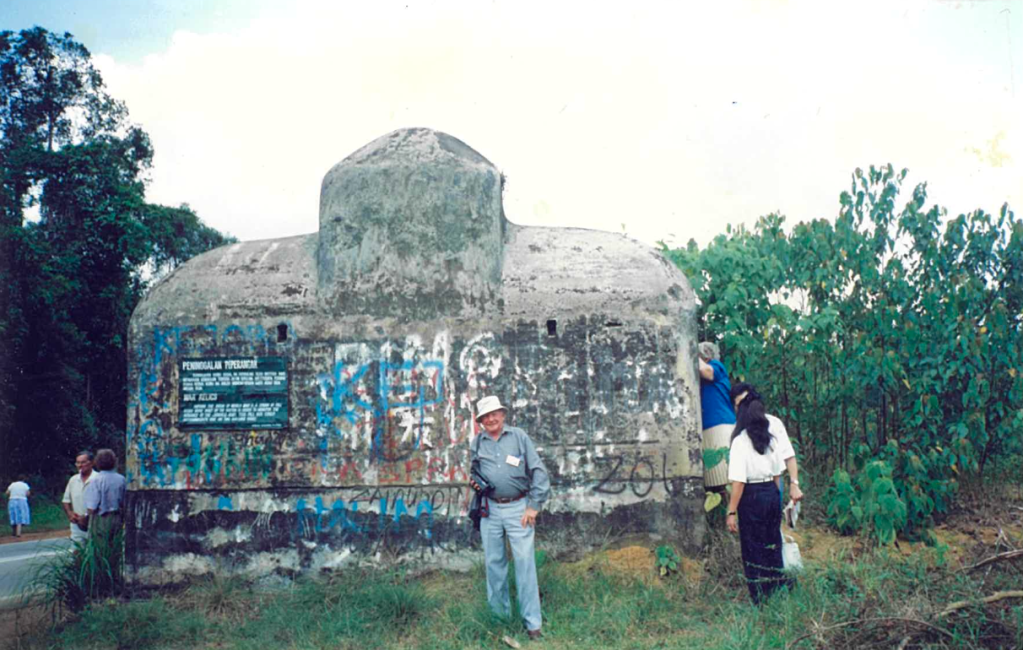
The following photograph of the pillbox was taken by Merv Blyth, with Nemo Dorph in the frame, on a trip commemorating the 50th Anniversary visit to Singapore. The second photograph is reprinted in an article marking the 90th anniversary of the Malay Regiment’s founding, published by author Stuart Lloyd in a history of a little-known chapter of World War II.
His book, The Malay Experiment: The Colonial Origins and Homegrown Heroism of the Malay Regiment, tells how a small experimental unit of Malay soldiers became a proud professional regiment, with its defining moment during the Battle for Singapore. It was here, on Pasir Panjang Ridge, that the Malay Regiment made its historic last stand — fighting to the last bullet and beyond — to hold back the invading Japanese forces in one of the most dramatic moments in Singapore’s wartime history.
“It’s a story of national pride, courage, and sacrifice — not just a military history,” said Stuart, who spent 10 years living in Singapore near the very site of this battle. The massive concrete pillbox, as seen in the accompanying photographs, is located just before Pasir Panjang Village.

FROM THE ARCHIVES.
Some of the House Rules, recorded by Major Okey in the camp at Blakang Mati
- War prisoners should never try to escape, either from outside or inside of the office.
- War prisoners who have no intention to escape should submit a declaration.
- War prisoners who have not submitted a declaration shall be locked in.
- For any act of insubordination or violence against an officer or watchman of the War Prisoners Camp, punishment under Military Law shall be very severe.
- War prisoners are required not to go out of the compound of the War Prisoners Camp without an order from the office.
- A meeting of war prisoners is prohibited except by permission of the Chief of Office.
- War prisoners should dignify the salutation and its manner, and they should march keeping step.
- For any Nippon Military Officer, or any other staff of this camp, the war prisoners should give the salute — but while they are working, they are not to salute.
- Serial numbers shall be given to all war prisoners instead of names, and the number shall be marked and affixed to the front of the body.
- War prisoners should live in the house allocated for them and should also sleep there. About fifty war prisoners should live in one house.
- War prisoners are permitted to read books which have been passed by the censorship of Japanese officers.
- At each house, the light should be put out at the fixed hour, but one light at the centre of each house should always remain on, and it is the duty of the night watchman to keep it lit.
- Communication to families is permitted once every month for commissioned officers and NCOs of highest rank; once every six weeks for NCOs; and once every two months for common soldiers. The time of communication and form of letter shall be instructed each time by the Chief.
- The war prisoners shall be permitted sports or intelligence games, but such activities should not interfere with their work or order.
- The war prisoners should try to learn the Nippon language and to know the real features of Nippon.
- For health and physical attendance, a Health Attendant shall be appointed from among the war prisoners, preferably one with medical knowledge or a related profession. The number shall be fixed according to the number of war prisoners.
- A Foodstuff Department shall be formed and required to attend to receiving foodstuffs, cooking, distribution, preparation of menus, and keeping the cooking room clean and tidy. It shall also maintain the cooking utensils, and manage water supply and discharge arrangements.
- War prisoners should always keep themselves clean, washing their bodies by means of cold-water baths.
- War prisoners shall be vaccinated once every year.
 218battalion.org.au